
Concrete or Polypropylene Pool: Which Is Better?
Short answer: A polypropylene pool is the optimal choice for most private clients: it is faster to build, less expensive, and requires no additional finishing. Concrete pools are suitable for custom shapes, large sizes, and projects featuring premium cladding. A third option — a concrete shell with a PVC liner — offers a happy medium: any shape at an affordable price, combined with easy liner replacement.
Why this comparison is important
This is the first and most common question clients ask: "Which material is best?" In Ukraine, most private pools are built using one of two materials: concrete or polypropylene. Concrete pool shells can feature two types of interior finishing—PVC liners or mosaic/tile—and these are fundamentally different options in terms of cost, aesthetics, and maintenance.
Over more than 10 years of operation, ModernPools has completed over 350 projects— ranging from compact family pools to large commercial pools for hotels and resorts. Below is an honest comparison, free from marketing exaggeration.
Key differences: comparison table
| Parameter | Polypropylene | Concrete + liner | Concrete + mosaic |
|---|---|---|---|
| Thickness / material | PP 5–8 mm | Solid sheet + PVC 1.5–2 mm | Monolithic + mosaic |
| Construction period | 21–28 days | 2.5–4 months | 3–5 months |
| Shape | Standard | Any | Any |
| Interior decoration | Not needed | PVC liner | Mosaic / Tile |
| Cost of the bowl | from €2,000 | from €5,000 | from €7,000 |
| Turnkey 6×3 m | from €15,000 | from €22,000 | from €28,000 |
| Surface replacement | Not required | Once every 8–12 years — fast | Spot repair |
| Surface repair | Welding / Patching | Easy, without dismantling | More complex, more expensive |
| Material warranty | from 7 years | of 5 years or more (liner) | of 5 years or more |
Polypropylene pool: advantages and limitations
Benefits

Installation speed. The pool shell is manufactured at the factory and delivered to the site, or welded directly on-site, before being installed in the excavation. The process—from excavation to filling with water—takes 21–28 days. Want to open a pool this season? Choose polypropylene.
Price. 30–60% cheaper than a concrete pool of the same size. A 5×2.5 m pool shell from ModernPools starts at €2,000. A turnkey pool starts at €10,000.
Does not require finishing. Polypropylene with a thickness of 5–8 mm serves as both a structural and a finishing material. Its smooth surface eliminates the need for annual coating applications or liner replacement.
Hygiene. The smooth, non-porous surface prevents algae and bacteria from attaching. Chemical consumption is lower.
Dismantling. If necessary, the basin can be removed using a crane and replaced with a larger one. Neither a liner nor a mosaic finish allows for this.
Guarantee. ModernPools offers a warranty of at least 7 years on polypropylene pool shells. The material is of German manufacture.
Restrictions
Form. Polypropylene is welded into standard configurations: rectangular, L-shaped, stepped-slope, with a children's area, or with a lap lane. Free-form organic shapes and complex radii require concrete.
Plus sizes. Pool shells larger than 12×6 m are more difficult to manufacture and transport. They are typically welded together from polypropylene sheets directly at the installation site. For very large pools, concrete is more practical.
Aesthetics. It is functional and durable, yet it cannot replace premium mosaic tiles or liners with diverse textures and colors in designer projects. Over time, it fades slightly along the waterline.
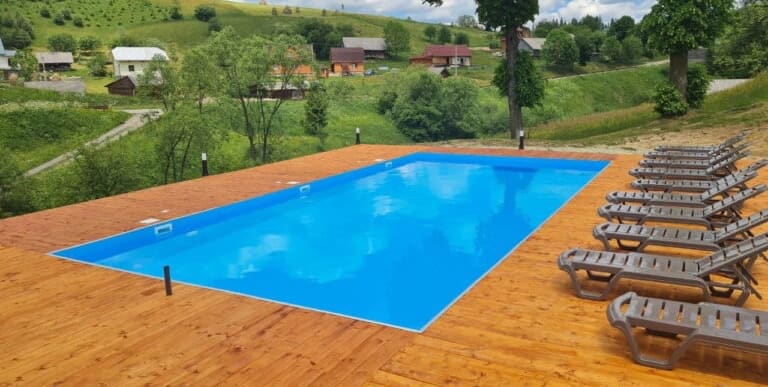
Concrete pool with a PVC liner: the happy medium
Why the liner is an underrated option
A PVC liner is a French or Spanish polyvinyl chloride membrane, 1.5–2 mm thick, that is bonded to the interior of a concrete pool shell. It combines the best of both worlds: the ability to accommodate any concrete structure shape while offering an affordable finishing solution.

Key advantage: easy replacement and repair.
This is what fundamentally distinguishes the liner from the mosaic:
- Replacement after 8–12 years — the crew removes the old film and applies a new one in 2–3 days. It costs a fraction of the price of re-laying mosaic or tile.
- Repairs right in the water — small cuts or punctures can be repaired with special patches within an hour, without draining the pool.
- Color replacement — want to change the design? A new liner in a different color or pattern — and the pool looks brand new.
When to choose a liner
- Non-standard pool shape — but the budget is limited
- You want to change the design every 10 years
- A commercial property where renovation speed is critical
- Combination of radii and straight sections
| Repair / replacement parameter | PVC liner | Mosaic / Tile |
|---|---|---|
| Small puncture / cut | Underwater patch, 1 hour | Replacement of a section + grouting, a few days |
| Complete replacement of the surfacing | 2–3 days, 1 brigade | 2–4 weeks, high cost |
| Option to change color | Yes, at every replacement | None (or complete dismantling) |
| Draining the pool for repairs | Not always (minor repairs — in the water) | Necessarily |
| Cost of complete replacement | Relatively affordable | Significantly higher |
Concrete pool with mosaic tiles: when the price is justified
Advantages of mosaic
Appearance. Smalt or glass mosaic represents the pinnacle of aesthetics. Bespoke murals, gradient transitions, and seamless integration with landscape design—when the pool is the centerpiece of the outdoor space, mosaic is unrivaled.
Durability. With proper installation and pH maintenance, the mosaic lasts 20–30 years without needing replacement. Isolated loose tiles can be repaired locally.
Tactile sensations. The textured surface of the mosaic is pleasant to the touch and slip-resistant, which is important for children's play areas and sports zones.
Mosaic limitations
- The cost of the finish is significantly higher than that of the liner
- Laying schedule — extends the construction period by 4–6 weeks
- Repairing widespread delamination is complex and costly.
- Grouting requires maintaining the correct water pH (otherwise, the grout darkens).

Selection algorithm: four questions
- No → polypropylene
- Yes → concrete with a liner or mosaic finish
- This summer → polypropylene only (14–21 days)
- Don't rush → any option
- Optimal price-quality ratio → polypropylene
- Any shape at a reasonable price → concrete + liner
- Unlimited Premium → concrete + mosaic
- Yes → polypropylene (without substitutions) or liner (simple replacement)
- Ready for complex repairs → mosaic
What ModernPools clients choose
From among more than 350 completed projects:
- Private clients — the majority opt for polypropylene. Optimal price, quick installation, and a long service life with no maintenance costs.
- Custom private projects — concrete with a liner: free-form shapes on a reasonable budget.
- Hotels, resorts, and holiday centers (Phoenix in Skhidnytsia and Polianytsia, RichOak Hotel in Bukovel, Milana Hotel in Polianytsia) — primarily concrete with a liner, sometimes featuring mosaic finishes: custom shapes, large volumes, and a premium aesthetic.

ModernPools Engineer Tip:
Don’t choose a pool type based on beautiful photos from Pinterest. Make your choice based on three real-world factors: your turnkey budget, the shape of your lot, and when you want to start swimming.
In 80% of cases, polypropylene is the right choice for a private home or summer house. It is better to invest the money saved into high-quality equipment—such as a heat pump, chlorine generator, or automatic pool cover—rather than into expensive mosaic tiling.
However, if the site has a complex shape or the design is a priority, consider concrete with a liner: you get any shape you want and the ability to easily update the surface after 10 years.
Frequently Asked Questions (FAQ)
Yes, these terms are interchangeable in casual conversation. Polypropylene (PP) with a thickness of 5–8 mm is a technical-grade polymer that is food-safe and resistant to chlorine, UV radiation, and temperature fluctuations. It should not be confused with thin household plastics.
For most private homes, a polypropylene pool is the optimal choice: it is faster to install, requires no additional interior finishing, and is generally less expensive. A concrete pool is the right choice if you require a custom shape, large dimensions, complex architecture, or a premium mosaic finish.
6×3 m polypropylene pool (turnkey) — from €15,000. 6×3 m concrete pool with liner — from €22,000. Concrete pool with mosaic finish — from €28,000, depending on the tiling. Get a free quote for your project — submit a request on the ModernPools website.
Depending on the selected package, a turnkey pool construction project includes design, site preparation and excavation, installation of the pool shell and embedded components, setup of filtration and pumping equipment, disinfection and heating systems, utility connections, and the final startup and configuration of the pool. The scope of work is agreed upon before construction begins, ensuring the client knows exactly what they are paying for.
The timeframe depends on the pool type and project complexity. A standard polypropylene pool can usually be completed in about 3–4 weeks. A concrete pool with a PVC liner takes longer—averaging several months—while a concrete pool with mosaic tiling requires even more time due to the concrete work and finishing. ModernPools determines the exact timeline after assessing the site and finalizing the project design.
With proper use and annual winterization, the lifespan is 30 to 50 years. ModernPools uses German polypropylene with a thickness of 5–8 mm and offers a warranty on the pool shell starting at 7 years.
Polypropylene can be welded into a wide range of configurations: rectangular, L-shaped, or designs featuring a children's area, a lap lane, or a stepped-slope bottom. Free-form organic shapes and complex architectural designs, however, are the domain of concrete.
A PVC liner has an average lifespan of 8–12 years. Replacement takes a crew 2–3 days and does not require dismantling the pool shell. Minor damage (punctures, cuts) can be repaired underwater in one hour using special patches, without draining the pool.
Yes. Special underwater adhesive and patches made from the same material allow for the repair of minor damage without draining the pool. This is one of the key practical advantages of a liner over mosaic tiles.
Mosaic is more durable (lasting 20–30 years without replacement), offers a premium look, and feels pleasant to the touch. A pool liner, on the other hand, is significantly cheaper to install and replace, can be repaired underwater, and allows for a design change with every replacement.
There is no fundamental difference regarding daily care: any pool requires filtration, pH monitoring, and water disinfection. The difference lies in the maintenance of the pool surface. Polypropylene does not require the replacement of the interior finish, whereas a PVC liner eventually needs replacing, and a mosaic finish may require localized repairs. Therefore, when making a choice, it is important to consider not only construction costs but also future maintenance and repair expenses.
Any more questions? We'll be happy to answer them!